Pricing is the decision that affects every other number in your business. Get it right and wages, rent, super and your own pay are covered with something left over. Get it slightly wrong and you can be flat out, fully booked and still going backwards. The most common pattern we see isn't businesses charging far too little. It's businesses charging a rate that was right two or three years ago, while wages, super, insurance and software have all moved on.
This guide shows you how to calculate a charge-out rate from your real costs, with a full worked example, and how to check it against utilisation, margin and discounts. It also covers pricing models, health and NDIS pricing, GST, and how to raise prices without losing good clients. Run your own numbers with our free pricing and margin calculator as you go.
Why pricing needs a fresh look in 2026
- Wage costs are higher. The super guarantee is 12%, award rates rise each July, and under Payday Super that super now leaves your account with every pay run.
- Card surcharges are changing. The card surcharge ban from 1 October 2026 means many businesses can no longer pass card fees on separately, so those costs need to sit inside your prices. See how to reprice for the surcharge ban.
- Overheads keep creeping. Insurance, rent, software subscriptions and professional fees rarely go down.
- Customers compare more. AI assistants and comparison sites make it easier for customers to shop around, which rewards businesses that can explain their value, not just their rate.
If you haven't recalculated your rates in the last twelve months, there's a good chance your margin has quietly shrunk.
The charge-out rate formula
A charge-out rate is the price you charge per hour of someone's time. It needs to cover three things: the cost of that person, their share of the business's overheads, and a profit.
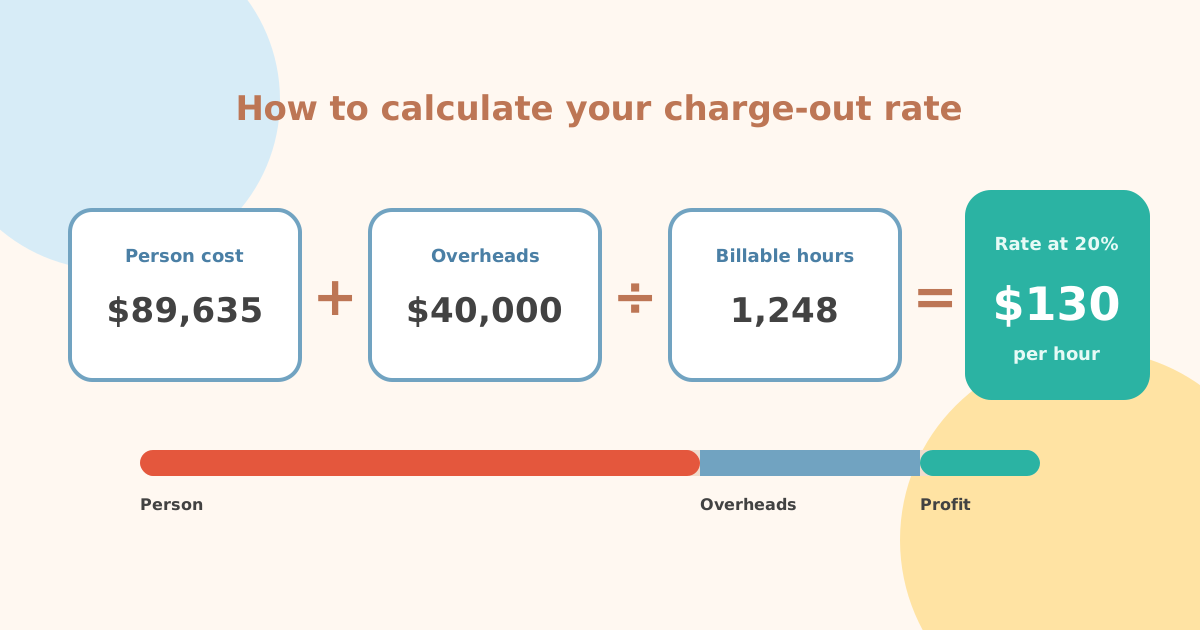
Cost per billable hour = (full yearly cost of the person + their share of overheads) ÷ billable hours a year
Charge-out rate (ex GST) = cost per billable hour ÷ (1 − target net margin)
Each part needs real numbers:
- Full yearly cost of the person: wage, super, leave loading, WorkCover, payroll tax if you're above the threshold, equipment and training. Our guide to employee costs walks through it, and the employee cost calculator does the maths.
- Share of overheads: rent, software, insurance, vehicles, marketing, accounting and admin wages, divided across the people who bill.
- Billable hours: paid hours, less leave and public holidays, multiplied by a realistic utilisation rate. This is the input owners most often overestimate.
- Target net margin: the profit you want left after every cost, including a fair wage for yourself.
Worked example: pricing an employee's time
Let's price the time of a full-time team member on a $75,000 salary in a business with three people who bill clients and $120,000 a year of overheads. These figures are illustrative; substitute your own.
| Step | Working | Result |
|---|---|---|
| 1. Full yearly cost of the employee | $75,000 wage + $9,000 super (12%) + about $1,010 leave loading + about $1,125 WorkCover (example 1.5%) + about $3,500 equipment and training | $89,635 |
| 2. Share of overheads | $120,000 overheads divided by 3 billable people | $40,000 |
| 3. Total cost to cover | $89,635 + $40,000 | $129,635 |
| 4. Hours available | 1,976 paid hours less annual leave, personal leave and public holidays | about 1,664 hours |
| 5. Billable hours | 1,664 x 75% utilisation | about 1,248 hours |
| 6. Cost per billable hour | $129,635 divided by 1,248 | about $103.87 |
| 7. Charge-out rate for a 20% net margin | $103.87 divided by 0.80 | about $129.84, round to $130 an hour |
| 8. Check | 1,248 hours x $130 = $162,240 revenue, less $129,635 costs | $32,605 profit, about 20% margin |
Notice how far the answer is from the employee's wage of about $38 an hour. A business charging $90 for this person's time would feel busy and productive, and lose about $14 on every hour billed. That's the "busy but broke" pattern in a single line of maths.
Pricing your own time as the owner
Owners often leave themselves out of the calculation, or price their own time at the same rate as the team. Your time should carry your market wage, and because owners spend more time on admin, sales and management, you usually bill fewer hours.
| Step | Working | Result |
|---|---|---|
| Owner market wage | What it would cost to employ someone to do your role | $110,000 |
| Super | 12% | $13,200 |
| Share of overheads | Same $40,000 share as each billable person | $40,000 |
| Total cost to cover | $110,000 + $13,200 + $40,000 | $163,200 |
| Billable hours | 1,664 available hours x 50% (the rest is running the business) | 832 hours |
| Cost per billable hour | $163,200 divided by 832 | about $196 |
| Charge-out rate at 20% margin | $196 divided by 0.80 | about $245 an hour |
If your rate is well below this, it doesn't automatically mean you should double it tomorrow. It means your profit is lower than it looks, your own pay is being subsidised by your team's margin, or both. That's exactly the kind of gap a monthly review should surface.
How utilisation changes the rate you need
Utilisation is the share of available hours that actually gets billed. It has a bigger effect on pricing than almost any other input, which is why a few empty appointments a week matter so much.
| Utilisation | Billable hours | Cost per billable hour | Rate needed |
|---|---|---|---|
| 60% | about 998 | about $129.84 | about $162 |
| 70% | about 1,165 | about $111.29 | about $139 |
| 75% | about 1,248 | about $103.87 | about $130 |
| 80% | about 1,331 | about $97.38 | about $122 |
| 90% | about 1,498 | about $86.56 | about $108 |
Two lessons sit in that table. First, if your utilisation is lower than you assumed, your real margin is lower than your price suggests. Second, improving utilisation, through better rostering, fewer cancellations or less unbilled admin, can do as much for profit as a price rise. Track it monthly; our guide to management report metrics shows how.
Markup vs margin: the mistake that costs the most
Markup is profit as a percentage of cost. Margin is profit as a percentage of price. They are not the same, and mixing them up is one of the most common pricing errors we see.
| Target margin | Markup on cost needed | Example: cost $100, price needed |
|---|---|---|
| 10% | 11.1% | $111.11 |
| 20% | 25% | $125.00 |
| 30% | 42.9% | $142.86 |
| 40% | 66.7% | $166.67 |
| 50% | 100% | $200.00 |
If you add 20% to your costs, you get a 16.7% margin, not 20%. Always work from margin: divide cost by one minus the margin you want.
What a discount really costs
Discounts feel generous and cheap. They're neither. Because a discount comes straight off your profit, a small cut in price needs a large increase in volume just to stand still.
| Discount | Profit per $100 sale | Extra volume needed to keep the same profit |
|---|---|---|
| None | $30 | None |
| 5% | $25 | 20% more sales |
| 10% | $20 | 50% more sales |
| 15% | $15 | 100% more sales |
| 20% | $10 | 200% more sales |
A 10% discount at a 30% margin means doing half as much work again for the same profit. If you want to reward loyal clients, consider adding value (a priority booking, a review call, an extra deliverable) rather than cutting price.
Choosing a pricing model
| Model | How it works | Works well for | Watch out for |
|---|---|---|---|
| Hourly | Charge for time spent | Variable or unpredictable work | Rewards slowness; clients watch the clock |
| Per appointment or session | Fixed fee per visit | Health and allied health, personal services | Session length creep and unpaid admin around each visit |
| Fixed fee or package | One price for a defined scope | Repeatable services with a clear outcome | Scope creep; needs a clear list of what is included |
| Retainer or subscription | Monthly fee for ongoing service | Bookkeeping, maintenance, ongoing care | Under-servicing or over-servicing against the fee |
| Value-based | Price tied to the value delivered | Advisory and specialist work | Harder to set; needs confidence and clear results |
Whatever the model, your charge-out rate is still the foundation. A package price is just an estimate of hours multiplied by your rate, plus a buffer for the unexpected.
Second example: pricing a fixed-fee package
Fixed-fee packages are popular with clients because they know the cost upfront. They only work for you if the price is built from your charge-out rate, with a realistic allowance for the parts of the job that always take longer than planned. Here's how to price a package, using the $130 an hour rate from the worked example.
| Step | Working | Result |
|---|---|---|
| 1. List every task | Initial consult 1.5 hrs, preparation 3 hrs, delivery 6 hrs, report and handover 2 hrs, client emails and calls 1.5 hrs | 14 hours |
| 2. Add a scope buffer | 15% for the unexpected: extra questions, a missed detail, a second revision | about 2.1 hours |
| 3. Total hours to price | 14 + 2.1 | about 16.1 hours |
| 4. Labour price | 16.1 hours x $130 | about $2,093 |
| 5. Materials or third-party costs | Supplier cost $300, plus a 25% markup for ordering and risk | $375 |
| 6. Package price | $2,093 + $375, rounded to a clean figure | $2,490 ex GST |
| 7. GST if taxable | $2,490 x 10% | $249, total $2,739 inc GST |
Two things make a package profitable over time. First, a written scope that says exactly what is included and what costs extra, so the job doesn't quietly grow. Second, tracking the actual hours on every package for the first few months. If the real average is 19 hours, not 16, the package needs repricing or the process needs tightening. Your management reports should show you which.
Common pricing mistakes
- Pricing from competitors instead of your costs. Their costs, team and margins aren't yours. Check the market, but start from your own numbers.
- Assuming 100% utilisation. Nobody bills every paid hour. Using paid hours instead of billable hours underprices every service.
- Leaving out the owner's wage. If your pricing only works because you don't pay yourself properly, it doesn't work.
- Confusing markup and margin. Adding 20% to cost gives a 16.7% margin.
- Never reviewing rates. A rate that was right in 2023 is probably too low after award increases, 12% super and higher overheads.
- Discounting by habit. Small regular discounts can wipe out a large share of your profit.
Pricing for dental, allied health and NDIS providers
Health businesses have extra constraints, but the same maths applies.
- Price per appointment, not per hour on the clock. A 45-minute consultation often comes with notes, reports and follow-up. Price the whole block of time, not just the face-to-face minutes.
- NDIS price limits. For NDIS-funded supports that are agency-managed or plan-managed, providers generally can't charge above the price limits in the NDIS Pricing Arrangements and Price Limits. Check the current limits, which change regularly, and make sure your cost per billable hour fits underneath them. Self-managed participants can negotiate.
- Medicare and private health. Rebates don't cap your private fees, but they shape what patients expect to pay out of pocket. Review your gap and communicate it clearly.
- Cancellation fees. A clear, fair cancellation policy protects utilisation. NDIS has specific short-notice cancellation rules, so follow them.
- Dental treatment plans. Material and lab costs move with suppliers, so review item fees and lab mark-ups at least yearly.
- GST. Most health services are GST-free when provided by a recognised professional and generally accepted as necessary, but products and some services aren't. Price those separately.
See our allied health, dental and NDIS bookkeeping pages for more on practice-specific setup.
GST, materials and products
- Work out every rate excluding GST. If you're registered and the service is taxable, add 10% on top when quoting. GST is the ATO's money, not part of your margin.
- Price materials separately with a markup that covers ordering, storage, wastage and the risk of defects, not just the supplier invoice.
- Include payment costs. Card and payment platform fees are a cost of doing business. With the surcharge ban, build them into your prices.
When and how to raise your prices
Most owners wait too long to raise prices, then do it all at once and worry about losing clients. Small, regular, explained increases work much better.
| Signal | Why it matters |
|---|---|
| Award wage increase on 1 July | Your biggest cost has gone up for every hour you sell |
| Gross margin falling three months in a row | Costs are outpacing prices |
| Wages as % of revenue rising | Each hour is costing more to deliver than before |
| Fully booked with a waitlist | Demand is higher than your price reflects |
| Card surcharge ban or new fees | Costs you used to pass on now sit with you |
| Your rate is below your calculated charge-out rate | Every hour sold is under-recovering cost |
When you raise prices:
- Give clear notice, usually around 30 days.
- Explain it simply. Most clients understand wage and cost increases.
- Remind them of the value: results, response times, expertise.
- Apply it consistently, and update Xero items, quote templates and booking software on the same day.
Our blog post on raising prices without losing clients has sample wording.
Track whether your pricing is working
A price is a hypothesis until your reports confirm it. Set up Xero so you can see profitability by service or job, using tracking categories or job costing, and look at it every month. The numbers to watch are gross margin by service, effective hourly rate (revenue divided by hours actually worked), utilisation and discounts given.
Margin and pricing reviews are often where we add the most value for clients, and by reviewing management reports and suggesting better ways of operating, we've found clients up to $30,000 a year in savings. If you'd like a second set of eyes on your pricing, book a free call. You can also download our pricing health check from the pricing and margin calculator page, and read our guide to gross vs net profit margin.
Frequently Asked Questions
How do I calculate my charge-out rate?
Add the full yearly cost of the person doing the work (wage, super, leave loading, WorkCover, equipment) to their share of your overheads, then divide by the hours they can realistically bill in a year. That gives your cost per billable hour. Divide that by one minus your target net margin, for example 0.8 for a 20% margin, to get a charge-out rate before GST.
What is a good profit margin for a service business?
It varies by industry and size, but many small service businesses aim for a net margin somewhere around 10 to 20% after paying the owner a fair wage. The more important test is your own trend: if your margin is falling while revenue grows, your prices have not kept up with your costs.
What is the difference between markup and margin?
Margin is profit as a percentage of the price; markup is profit as a percentage of the cost. A 25% markup only gives a 20% margin. Confusing the two is one of the most common reasons businesses underprice, because adding 20% to cost does not give a 20% margin.
How many billable hours should I use in my pricing?
Start with paid hours, take out annual leave, personal leave and public holidays, then apply a realistic utilisation rate for admin, travel and downtime. For a full-time employee that is often around 1,100 to 1,350 billable hours a year, and owners usually bill fewer hours than their team.
Should my prices include GST?
Work out your charge-out rate excluding GST first. If you are registered for GST and the service is taxable, add 10% on top when you quote or invoice consumers, and show prices inclusive of GST where the law requires it. Many health services are GST-free, so check how your services are treated.
How often should I review my prices?
At least once a year, ideally before 1 July when award wages rise, and any time a major cost changes, such as super, rent, insurance or card fees. Also review when your utilisation drops or your margin falls for three months in a row.
Can I charge NDIS participants more than the price limit?
For supports funded through the NDIS that are agency-managed or plan-managed, registered and unregistered providers generally cannot charge more than the price limits in the NDIS Pricing Arrangements and Price Limits. Check the current arrangements, which are updated regularly, and price your private and non-NDIS work separately.
How do I raise my prices without losing clients?
Give clear notice, usually around 30 days, explain the change in plain terms and the value clients receive, and apply it consistently. Most clients accept a reasonable increase, especially when it is linked to real cost increases such as wages and super. Update your quote templates, Xero items and booking software on the same day.