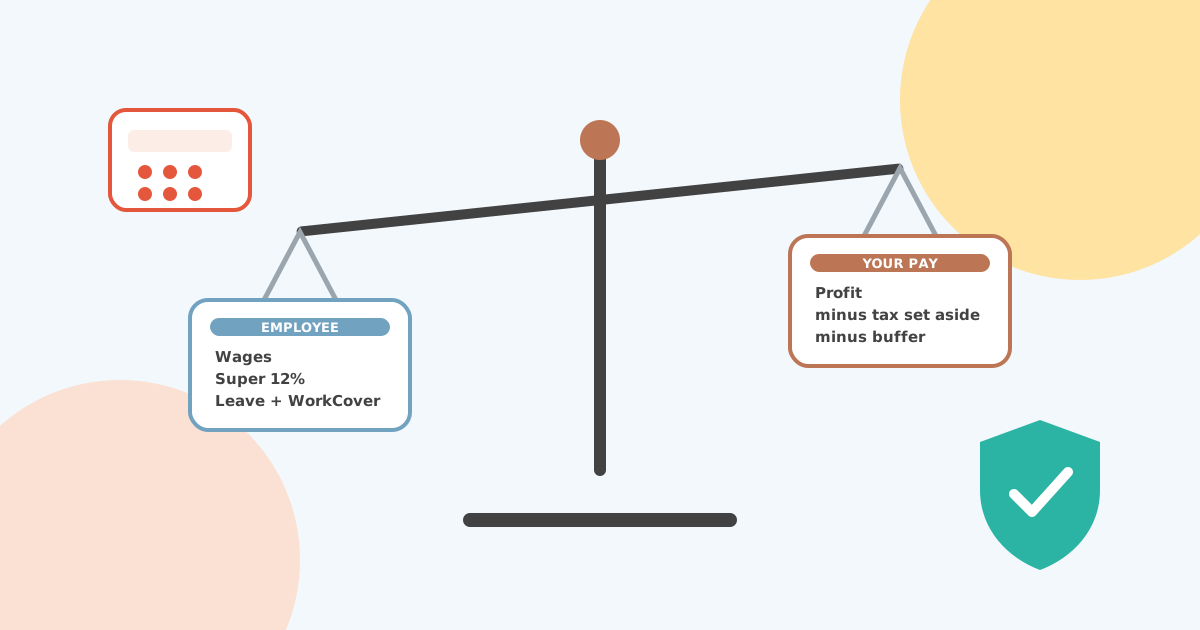
Two of the hardest money questions in a small business sit right next to each other. Can I afford to hire someone? And how much can I actually afford to pay myself? Most owners answer both by looking at the bank balance and hoping. It's an understandable habit, but it's how good businesses end up with a team they can't really afford and an owner who hasn't had a pay rise in three years.
This guide works through both questions properly: what an employee really costs, how to work out a sustainable wage for yourself, what to think about before you hire (including WorkCover, payroll tax and portable long service leave in Victoria), the insurance owners commonly look at, and why having someone keep you accountable to your numbers makes all of it easier. Use our free employee cost calculator alongside it to run your own figures.
What an employee really costs
The wage is only the starting point. Every employee comes with on-costs, and some of them don't show up until a few months in.
| Cost | What it is | Typical size |
|---|---|---|
| Superannuation | Super guarantee on ordinary time earnings, now paid with every pay run under Payday Super | 12% of ordinary earnings |
| Annual leave | Four weeks a year for full-time staff (pro rata for part-time) | About 7.7% of the year paid but not worked |
| Leave loading | Extra payment on annual leave where the award or agreement requires it | Commonly 17.5% of the leave pay |
| Personal (sick and carer's) leave | Ten days a year for full-time staff | Up to about 3.8% of the year |
| Public holidays | Paid days off that are not billable | Around ten to thirteen days a year depending on your state |
| Workers compensation (WorkCover) | Compulsory insurance for workplace injury | A percentage of wages set by your industry rate |
| Payroll tax | State tax once total wages pass the threshold | Nil until you pass the threshold; 4.85% above $1m in Victoria |
| Portable long service levy | Applies in some Victorian industries, including community services | A levy on ordinary pay where it applies |
| Equipment, software and uniforms | Laptop, phone, licences, PPE | Often $1,500 to $5,000 in year one |
| Recruitment and training | Advertising, onboarding, your time and theirs while they learn | Easy to underestimate; often weeks of reduced output |
Add it up and many small businesses find a new team member costs roughly 20 to 30% more than their base wage, before you count the hours they're paid but not working. That second part is what catches service businesses out.
The number that matters: cost per billable hour
In a service business, an employee earns their keep through the hours you can bill or treat, not the hours they are paid. So the real question isn't "what's their salary?" It's "what does each billable hour cost me, and do I charge enough above that?"
| Step | Working | Result |
|---|---|---|
| Base wage | Annual salary | $75,000 |
| Super | 12% of $75,000 | $9,000 |
| Leave loading | 17.5% of four weeks' pay, if the award requires it | about $1,010 |
| WorkCover | Example only at 1.5% of wages; your industry rate will differ | about $1,125 |
| Equipment, software, training | Year-one estimate | about $3,500 |
| Total yearly cost | about $89,635 | |
| Paid hours | 38 hours x 52 weeks | 1,976 hours |
| Hours actually available | Less 4 weeks annual leave, about 10 days personal leave and about 11 public holidays | about 1,664 hours |
| Billable hours at 75% utilisation | 1,664 x 75% | about 1,248 hours |
| Cost per billable hour | $89,635 divided by 1,248 | about $72 an hour |
In this example the employee earns about $38 an hour on paper, but costs the business about $72 for every hour that can actually be billed. If you charge $95 an hour for their time, there's a margin. If you charge $70, every hour they work loses you money, however busy everyone feels. The employee cost calculator does this for your own numbers in a couple of minutes, and the pricing and margin calculator shows what to charge. For the full method, see our guide on how to calculate your charge-out rate.
How much can you afford to pay yourself?
Many owners pay themselves last and least, taking whatever is left at the end of the month. It feels responsible, but it hides the true profitability of the business and makes personal finances unpredictable. A better approach is to work out a sustainable owner pay from your numbers, then pay it on a schedule.
A simple way to work it out
| Step | What to do | Example |
|---|---|---|
| 1. Average profit before owner pay | Net profit per month, before any wage or drawings to you | $14,000 |
| 2. Tax provision | Set aside for income tax on that profit (your accountant can give you a percentage) | minus $3,500 |
| 3. Debt repayments | Loan and hire purchase principal not already in the profit and loss | minus $1,200 |
| 4. Reinvestment | Money you plan to put back in: equipment, marketing, a future hire | minus $1,500 |
| 5. Buffer top-up | Until you hold two to three months of expenses in reserve | minus $1,000 |
| Sustainable owner pay | What remains, paid monthly | about $6,800 a month |
If the answer is lower than you hoped, that's useful information, not a failure. It tells you whether the fix is pricing, costs, utilisation or the structure of the business. Ask yourself one more question too: what would it cost to pay someone else to do your job? If the business can't afford to pay you something close to that, its real profit is lower than the profit and loss suggests.
Wage, drawings or dividends?
- Sole traders and partnerships take drawings. They aren't a business expense, and you pay income tax on the business profit, so set tax aside from every drawing.
- Company directors are usually paid a wage through payroll, with PAYG withholding and super, and may also receive dividends. Taking money from a company account without a wage, dividend or properly documented loan can create Division 7A problems. Our guide to reasonable remuneration for company directors explains the ATO's view.
- Trusts distribute profits to beneficiaries, which needs planning before 30 June each year.
The right mix depends on your structure and personal situation, so set it up with your accountant. If you're unsure which structure suits you, see sole trader vs company and company vs trust.
What to consider before you hire
Hiring is a cash flow decision before it is a staffing decision. Before you advertise, check:
- Is the work consistent? Turning work away every week is a hiring signal. One busy month isn't.
- Can cash flow carry the role for three to six months while they get up to speed and before their work fully pays for itself?
- Does your margin hold once the true cost per billable hour is in your pricing?
- Employee or contractor? Getting this wrong can mean back-payments of super, tax and entitlements. The ATO's employee or contractor decision tool is a good first check.
- Which award and classification applies, including penalty rates, allowances and minimum engagement. A wrong classification can underpay staff for years without anyone noticing.
- What paperwork is needed: employment contract, Fair Work Information Statement (and the Casual Employment Information Statement for casuals), TFN declaration, super fund details or a stapled fund request, and Single Touch Payroll set up in Xero.
Our step-by-step guide on when to hire your first employee covers the setup checklist in detail.
Hiring in Victoria: WorkCover, payroll tax and portable long service
Employment rules are mostly national, but workers compensation, payroll tax and portable long service are run by each state. For Victorian employers, three things matter most.
| Obligation | When it applies | Who runs it | What to do |
|---|---|---|---|
| WorkCover insurance | If you pay, or expect to pay, more than $7,500 in rateable remuneration a year, or employ apprentices or trainees | WorkSafe Victoria | Register before your wage bill passes the threshold; your premium is based on remuneration and industry rate |
| Payroll tax | Once total Australian wages exceed $1,000,000 a year (from 1 July 2025); 4.85% above the threshold, lower for eligible regional employers | State Revenue Office Victoria | Track your total wage bill, including super and grouped entities |
| Portable long service | Community services (including many NDIS and disability support providers), contract cleaning and security | Portable Long Service Benefits Authority | Register and report quarterly if your industry is covered |
Two details catch Victorian businesses out. First, some contractors are treated as workers for WorkCover purposes, so a team of contractors doesn't automatically mean no WorkCover. Second, payroll tax counts super and some allowances as wages, and related businesses can be grouped, so you can cross the threshold sooner than you think. Our Victorian payroll tax guide and payroll tax by state comparison have the details. Outside Victoria, each state has its own workers compensation scheme, such as icare in New South Wales or WorkCover Queensland.
The insurance owners commonly look at when they start hiring
True Tally isn't an insurance broker and we don't give personal insurance advice. But when clients start hiring, these are the types of cover we commonly suggest they look into and discuss with a licensed provider.
| Cover | What it generally protects | Who often needs it |
|---|---|---|
| Workers compensation | Employee injury and illness at work | Compulsory for most employers |
| Public liability | Injury or property damage to clients and the public | Almost every business with clients or premises |
| Professional indemnity | Claims arising from your advice or professional services | Health, allied health, legal, consulting, bookkeeping and other advice-based work |
| Management liability | Claims against directors and the business, often including employment practices claims and some regulatory investigations | Companies with staff, especially as the team grows |
| Cyber insurance | Data breaches, cyber attacks and the cost of responding | Anyone holding client, patient or payment data |
| Business insurance (contents, interruption) | Equipment, stock and lost income after an insured event | Businesses with premises, equipment or stock |
Management liability is worth a closer look once you employ, because claims from employees, such as unfair dismissal or discrimination, can arise even when you've done nothing wrong, and defending them is expensive. You can compare business insurance and request quotes on our insurance page, or get a quote through BizCover. If you use the BizCover link, True Tally may receive a commission at no extra cost to you.
Why having someone keep you accountable matters
Most owners already know they should check their margins, watch wages and pay themselves properly. The problem isn't knowledge. It's that when the business is busy, the numbers slide to "later", and later becomes BAS time. By then a pricing problem has run for a quarter, a cash squeeze has already arrived, and a hire has been made on a gut feeling.
Having someone keep you accountable changes that. It's the same reason people book a personal trainer: not because they don't know how to exercise, but because a set time and someone who notices makes it happen.
Here's what that looks like with True Tally's management reporting:
- Your books are fully reconciled on a schedule that suits you (twice a week, fortnightly or monthly), so the numbers you read are right.
- You get a monthly report pack with your key metrics on one page, including wages as a percentage of revenue, margin, cash runway and debtor days.
- We meet to go through it, in plain English, and agree what to act on.
- We speak up early when wages are creeping up, when pricing hasn't kept pace with costs, when cash is tightening, or when it's time to audit payroll and award classifications. You don't have to ask.
- We help you plan your own pay and test whether a new hire stacks up before you commit.
- We bring in the right people when you need them, including your accountant, a broker, insurance or HR support.
The results are practical. By reviewing clients' management reports and proposing better ways of operating, we've found clients up to $30,000 a year in savings. Margin and pricing reviews are often where we add the most value, especially for owners who are earning more on paper but keeping less as costs rise. And we've never lodged a client's BAS late. We run payroll for teams from two staff up to 150, with significant ongoing training in awards such as SCHADS.
If you'd like that kind of support, book a free call. See also our payroll services, CFO as a service and our guide to the management report metrics to track in 2026.
A quick checklist before your next hire or pay rise
| Check | Done when |
|---|---|
| True cost of the role | You have run the employee cost calculator with the real award rate |
| Cost per billable hour vs your price | Your charge-out rate leaves a healthy margin |
| Cash runway | You can carry the role for three to six months |
| Owner pay | Your own sustainable pay is set and still affordable after the hire |
| Award, classification and contract | Checked, documented and set up in payroll |
| WorkCover, payroll tax, portable long service | Registered or confirmed not required for your state and industry |
| Insurance | Workers compensation in place; other cover reviewed with a licensed provider |
| Monthly review | A set date each month to check wages, margin and cash with your bookkeeper |
Frequently Asked Questions
How much does an employee really cost in Australia?
Usually well above their wage. On top of salary you pay 12% super, paid annual and personal leave, leave loading where the award requires it, workers compensation insurance, payroll tax once your wages pass the state threshold, plus equipment, software, recruitment, training and management time. Many small businesses find the full cost lands roughly 20 to 30% above the base wage, before counting the hours lost to leave and public holidays. Our free employee cost calculator works it out for your numbers.
How much can I afford to pay myself from my business?
Start with your average monthly profit before paying yourself over the last six to twelve months. Take off a provision for income tax, any loan repayments, money you plan to reinvest and a top-up to your cash buffer. What is left is a sustainable owner pay. Pay yourself a fixed amount each month rather than whatever is in the account, and review it every quarter with your bookkeeper.
Should I pay myself a wage or take drawings?
It depends on your structure. Sole traders and partners take drawings, which are not a tax deduction, and pay tax on the business profit. Company directors are usually paid a wage through payroll with PAYG withholding and super, and may also receive dividends. Taking money out of a company without the right paperwork can trigger Division 7A problems, so check the mix with your accountant.
Do I need WorkCover in Victoria?
WorkSafe Victoria requires employers to register for WorkCover insurance if they pay, or expect to pay, more than $7,500 in rateable remuneration in a financial year, or if they employ apprentices or trainees. Some contractors can also count as workers for WorkCover purposes. Your premium is set from your remuneration and your industry classification, so check WorkSafe Victoria's current requirements before your first hire.
When does payroll tax start in Victoria?
Victorian payroll tax applies once total Australian wages pass the $1,000,000 annual threshold (from 1 July 2025), at 4.85% on wages above it, with a lower rate for eligible regional employers. Related businesses can be grouped and share one threshold, and super and some allowances count as wages, so track your total wage bill as you grow.
What insurance does a small business need when it starts hiring?
Workers compensation is compulsory once you employ in most cases. Beyond that, owners commonly look at public liability, professional indemnity for advice-based and health services, management liability (which can cover employment practices claims and some regulatory fines), and cyber cover if you hold client data. The right mix depends on your industry, so compare policies and get advice from a licensed provider.
When can I afford to hire my first employee?
When you are consistently turning work away or doing tasks someone else could do at a lower hourly cost, and your cash flow can carry the full cost of the role for at least three to six months while they ramp up. Work out the true cost per billable hour first, and check your margin still holds once the new wage is in.
Why does having someone keep you accountable help?
Because most owners know what they should be watching but rarely make the time when the business is busy. A bookkeeper who sends a monthly report pack, meets with you, and flags when wages, margins or cash are drifting turns good intentions into a routine. It catches problems while they are still small and makes decisions like hiring or a pay rise for yourself much less of a gamble.